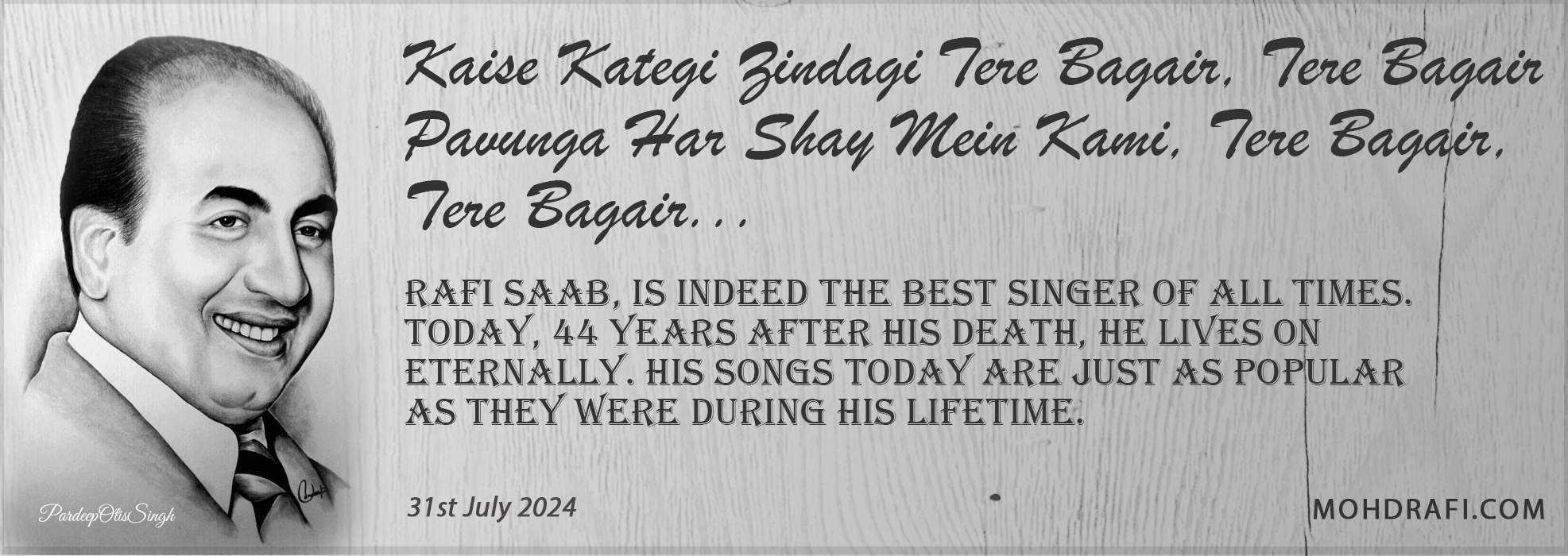
Rafi with Music Composers – Part 1
This article is written by Mr. Anmol Singh.
Rafi Saab has worked with the maximum number of music composers from different era. Most Music Composers came from diverse backgrounds and cultures, which were unique in their own respect. Every one brought a treasury of melody, which directly inherited the surroundings and environment in which they were brought up. Most of the music composers had an excellent knowledge of Raags and their application in different situations based on the film’s story line. Many could compose a song based on multiple Raags. Here are a few listed gems that contributed to Rafi Saab’s success. It’s an attempt to understand the depth of Rafi Saab’s work.
Note to Readers: The writer is not an expert in Classical Music. The information on Raags of many songs is not known. Perhaps many Raags mentioned for the songs mentioned below may not be correct. It is a request to all the readers to provide correct information in case of any misrepresentation of information mentioned in the following articles in any form.
Rafi with Naushad
Naushad Ali was instrumental in the movement of classical music from various Garaanas to the masses. Naushad is the man who explored the true worth of Rafi’s voice. Prior to the Baiju Bawra, Naushad used Rafi initially to sing in chorus. Rafi Saab had a desire to sing with the legendary singer K L Saigal. Naushad full fills his dream in the film ‘Shah Jahan’, where Rafi sings a duet with K L Saigal, “Mera Sapnon Ki Raniâ€. But it was “O Duniya Ke Rakhwale†based on Raag Darbari, “Mann Tadpat Hari Darshan†based on Raag Malcoz and later “Mabhubann Mein Radhika†based on Raag Hameer brought the best of Rafi. For the song “Madhudann Mein Radhika†Dilip Kumar undergoes training for playing sitar for six months prior to the shooting of the song sequence. (Courtesy Naushad’s Interview in Zee TV).
Naushad Saab originally hails from Lucknow the City of Nawabs. No music composer apart from Naushad could have composed the scores for Mere Mehboob, Palki and Pakeeza, which portray the culture of the Nawabs the best. Gulam Mohammed originally scored music of Pakeeza. Naushad later completed the scores of Pakeeza after his death. Rafi Saab provides a masterpiece performance for songs like “Mere Mehboob Tujhe Meri†based on Raag Jhinjhoti, “Aye Husna Zara Jaagâ€, “Yaad Mein Teri Jaag Jaag†based on Raag Bhairavi / Darbari Kanada, “Dil-e-Betaab Ko Sine†based on Raag Kalyan, “Kal Raat Zindage Seâ€, “Chalo Dil Dar Chaloâ€, etc.
Apart from Ghazals, Naushad Saab has contributed in folk music of Uttar Pradesh also. Rafi sings the Bhojpuri classic “Nain Ladgai Hai To Mannwa Maa†from Ganga Jamuna. Dilip Kumar provides a super performance. In the all time classic ‘Mother India’, Naushad Saab again uses folk music for composition of most of the songs. Rafi Saab provides great performances in the form of duets with Shamshad Begum and Lata, “O Ghadi Waleâ€, “Dukh Bhare Din Bite†based on Raag Megh Malhar, “Matwale Jiya Dole Piya†and a fun solo “Na Mein Bhagwan Hoonâ€. Coming to devotional songs Rafi Saab contributes in ‘Amar’, “Insaaf Ka Mandir Hai†a master piece of all times based on Raag Bhairavi. In Mugal-E-Azam Naushad chooses Rafi for “Zindabad Aye Mohabatt†for a very high pitch operation.
Rafi Saab’s capability of operating at very high pitch effortlessly has benefited many music composers; where they enjoyed the liberty to exploit Rafi Saab’s potential to any extend to achieve the best results. Full marks to Naushad to bring Rafi Saab to such a level. It is believed that Rafi Saab had to rehearse the song “O Duniya Ke Rakhawale†for almost 28 days, where during rehearsal his throat started bleeding. But the initial pain, which Rafi Saab went through, indeed made him the ‘King of Melody’ there after. Apart from Rafi Saab Naushad was instrumental in shaping Mukesh to his original style of singing via songs “Tu Kahe Agar†& “Gaae Ja Geet Milan Keâ€.
Some ever lasting solos delivery by Rafi Saab for Naushad include “Suhani Raat Dhal Chuki†based on Raag Pahadi, “Meri Kahani Bhulane Wale†based on Raag Tilang, “Aaj Purani Raahon Seâ€, “Aaj Ki Raat Mere†based on Raag Pahadi, “O Door Ke Musafir Hum ko â€, “Maan Mera Ahsaanâ€, “Ye Zindagi ke Meleâ€, “Koyi Saagar Dil Ko†based on Janasamohini / Kalavati, “Tere Kuche Mein Armanoâ€, “Mohobbat Ki Raahon Mein Chal Naâ€, “Nasib Dar Pe Tere Aazamaaneâ€, “Mere Pairon Mein Ghungrooâ€, “Zindagi Aaj Mere Naam Se†based on Raag Jaijaivanti. The duets with Lata “Do Sitaroon Ka Milan†from ‘Kohinoor’ based on Raag Pahadi and “Dil Todne Wale†from ‘Son of India’ are just superb. Two catchy duets with Lata & Shamshad Begum from ‘Baiju Bawra’ can be heard till date “Door Koi Gaaye Dhun†based on Raag Desh & “Tu Ganga Ki Mouj Mein†based on Raag Bhairavi. Another duet with Lata “Dilruba Maine Tere Pyar†from ‘Dil Diya Dard Liya’ is remarkable, although the film was a flop but the songs were big hit. There is another classical duet song with Lata from the same film equally remarkable, “Sawan Aye Ya Ne Aye†based on Raag Sarang.
A duet with Talat and separately sung with Mahendra Kapoor, “Kaise Haseen Aaj Baharon ki Raat†from the film ‘Aadmi’ is also mind blowing. The duet audio version with Mahendra Kapoor is unreleased officially. But it is indeed great to see the Guru and Chela (Student) singing together effortlessly. Mahendra Kapoor considered Rafi Saab as his Guru when he was a teenager. All songs from the film ‘Leader’ are just mind blowing & too good, whether patriotic “Apni Azaadi Ko Ham Hargizâ€, fun song “Mujeh Duniyawalon†or romantic numbers “Hamin Se Mohobbatâ€, “Ek Shehenshah Ne†based on Raag Lalit, “Tere Husn Ki Kya†based on Raag Kalyan. The last two songs are again remarkable duets with Lata. “Hamse Tho Aachi Teri Payal†another super duet with Lata from ‘Ganwaar’.
Rafi Saab had sung songs for two film ‘Love & God’ & ‘Dharam Kanta’ under Naushad which were released later after Rafi Saab’s death.
Rafi with S D Burman
It is said, that wine matures with time. The same can be said for S D Burman’s (Dada) compositions also. As he grew old by age his compositions became younger & matured with time. Dada originally hails from the Royal family of Tripura. Dada sacrificed his entire wealth and Royal status just for the love of music. His sacrifice did not go in vain; in fact he was destined to rule masses perhaps not as the King of Tripura, but ‘The King of Music’.
It is believed that Dev Anand and Dada are made for each other. Dev Anand once mentioned in his interview that mountains facsinate him the most. Perhaps there is no composer, who understands the music of mountains and hills better than Dada Burman. Most Dev Anand songs sequences are picturized on Mountains and Hills. Dev has been a thorough Kishore Kumar supporter right from the begining of his career. Dada is the man instrumental in shaping Kishore. But when it comes to masterpiece performances Dada over rules Dev and chooses none other then Rafi Saab. Whether it is a song based on Bengali folk music “Saathi Na Koi Manzil†from ‘Bambai ka Babu’ or a haunting duet with Lata “Dil Pukare Aa Re Aa Re†from ‘Jewel Thief’, shot in the hills of North East or an ever lasting Ghazal from ‘Kala Pani’, “Hum Bekhudi Mein†it is just Rafi Saab’s voice that will he do the true justice to Dada’s work.
If we talk of bitter realities of life expressed through songs “Ye Mahalon Ye Taqtonâ€, “Dekhi Zamane Ki Yaariâ€, “Jinhe Naaz Hai Hind Par†again Rafi does the true justice to Guru Dutt’s body language. Guru Dutt does an excellent job on screen.
For Dada’s classical composition for the song “Nache Mann Moraa, Magan Tig Da Dhigi Dhigi†again there is Rafi who provides a master performance. The song is picturized on an ugly character played by the legendary Ashok Kumar (Dada Munni). Practically it is difficult to compose a song for such a character. But when two geniuses like Dada Burman and Rafi Saab come together, they create magic and completely super seed the ugly image with their super performance. Composing a song of such a variety indeed speaks of Dada’s true caliper as a composer. No wonder Dada was the most versatile music composer of all times. From the same film there is another masterpiece composition based on Raag Kaafi / Pilu, sung by Rafi Saab for Dada Munni, “Tere Bin Sune Nayan Hamareâ€. It’s duet with Lata.
For Romantic solos songs Dada chooses Rafi to render “Khoya Khoya Chandâ€, “Tere Mere Sapne†based on Raag Gara, “Kya Se Kya Ho Gayaaâ€, “Dil Ka Bhanvarâ€, “Tu Kahaan Ye Bataaâ€, “Apni Tho Har Aah Ik Toofaan Haiâ€, etc. Dada was not a Ghazal specialist like Madan Mohan, but the ones composed by him are no less, apart from the one from Kaala Pani there are, “Ase To Naa Dhekho†based on Raag Gara, “Dil Dhal Jaaye Haiâ€, “Kahin Bekhayaal Ho Keâ€, etc.
The duets along with Lata, Asha & Geeta Dutt which Rafi Saab sung under Dada are truly sensational, “Chand Saa Mukhdaâ€, “Hum Aapki Aakhon Meinâ€, “Rim Jhim Ke Taraneâ€, “Gun Guna Rahe Hai Bhavarâ€, “Baagon Mein Bahaarâ€, “Palkon Ke Peeche Se Kyaâ€, “Tere Ghar Ke Samneâ€, etc. In the song “Dekho Rutha Na Karoâ€, Dada uses Rafi at a very high pitch in the antara compared to Lata.
Dada along with Majrooh Sultanpuri holds the credit in composition of some of the catchiest duets of all times i.e. songs involving couples in joy full mood. “Aaja Panchi Akela Haiâ€, “Acha Jee Mein Haariâ€, “Diwana Mastaana Huga Dilâ€, “Dekho Ji Mera Haalâ€, “Kali Ke Roop Mein†are duets sung by Rafi Saab along with Asha are few examples. This strategy followed by Dada turned out to be instrumental in shaping Kishore Kumar. The duets, which Dada has composed for Kishore, are one of the best of all times.
After the success of Aradhana, Dada indeed used Kishore Kumar more than any other singer. Though critics did accused Dada of being partial towards Kishore. But that’s not the truth. Dada indeed used Rafi Saab after 1969 for many unforgettable compositions in the form of Solos and duets. To start with there is a patriotic number from ‘Prem Pujari’, “Taqat Watan Ki Hum Se†Dada chooses Rafi along with Manna Dey. The solo songs consist of “Mera Mann Tera Pyasaa†& “Mehebooba Teri Tasaveer†and duets with Lata, “Teri Bindiya Re†where Rafi sings for Amitabh, “Voh Kya Hai†from ‘Auraag’, “Yeh Dil Deewana Hai†where Rafi sings for Dharmendra. The last song, which Rafi Saab sang for the Prince of Tripura, was “Sa Ra Ga Ma†which is a fun duet with Kishore from ‘Chupke Chupke’. Few days after the recording the Prince went into comma forever and left us in Oct 1975.
Anyone,
please let me know to trace Md Rafi’s bhajan on Hari
Govardhanagiri dhara
raag Durbari kanada
composed by Naushad
This i remembered to have heard
Also mentioned in Playlist of Thiruvengadam
Burman will forever be remembered for that mesmerising Mohammad Rafi number lipsed by Dev Anand in Guide —- ‘tere mere sapnay ab eik hi rang hain / wo jahan bhi le jaayen rahen / hum sang hain’. And if you have had occasion to listen to another Rafi number, ‘hum bekhudi mein tum ko pukaare chale gaye’, you might as well recall that Burman had simply transplanted the music from his earlier Bengali song, ‘ghoom bhulechhi nijhum nishithe jege thaki / ar amari moto jaage neerhe duti pakhi.
for more on Dada Burman go to
http://www.ndtvblogs.com/views/viewcomments.asp?gl_guid=&q_blogid=6101&blogname=palashbiswas
As a tribute to my favourite singer, I am posting the typewritten version of
a special Jaimala program presented by the Shehanshah-e-Mausiqui, Naushad
Sahab, in the memory of Mohammed Rafi.
[Jaimala was a popular Vividh Bharati program for “Fauji Bhai”s and the
Vishesh Jaimala used to be presented by a famous (usually film) personality.]
Although Rafi Sahab sang under the baton of almost all music directors of the
Hindi film industry, his association with Naushad was special. Naushad was
instrumental in grooming this highly talented singer, although he modestly says
that he “merely showed Rafi the right direction”.
Here’s the special Jaimala program which I have translated into English from
the original Urdu version. The beauty of Naushad’s refined Urdu is certainly
lost in the translation, but I hope you will enjoy reading what the legendary
music director has to say regarding Mohammed Rafi, the singer and the person.
Portions which cud not be translated properly have been left in the original
language. All errors in translation are mine.
The songs played in the program are included in “[….]”.
May Rafi Sahab’s soul rest in peace.
Sami Mohammed (A MOHAMMED RAFI fan)
***** Yaad-e-Rafi (Naushad’s Jaimala) *****
Fauji bhaion ko Naushad ka salaam!
[Unfortunately, the initial statements made by Naushad in the program got
erased from my cassette by mistake. Naushad recollects the moment when Rafi
Sahab had first approached him with a letter of recommendation from someone]
It was recommended that this young man, who possesses a beautiful voice, be
given a chance to sing. I heard the young man sing a song or two and was
highly impressed. I told him that one day he would become a great singer and
asked him to keep in touch. During the initial stages, I let the young man be
a part of a chorus, and I think one such chorus “Hindustan ke hum hain,
Hindustan humara….” might still be embedded in your memories. Later, in the
film Dillagi, I had the opportunity to use his voice exclusively in a solo. As
if it were predestined, this song became immensely popular throughout the
country. This was my first song (solo) with him. With this song, Rafi Sahab
not only carved a niche for himself, but also added a new dimension to my music.
[Tere kooche me armaanon ki duniya leke aaya hun
Tujhi par jaan dene ki tammanna leke aaya hun ]
After that, Rafi Sabab never looked back. He earned respect and his popularity
touched the sky. The magic of his voice enthralled the whole world. His
popularity, respect and wealth all increased tremendously, YET he ALWAYS
remained modest. Like a fruit-bearing tree, the more he fructified, the more
he bent in front of the world. His heart was filled with fear of God and the
love for truth. Generosity and altruism were part of his system. God and truth
were the only sources of inspiration for him. And he always used to say
“Tum yahan jaisa karoge waisa bharoge, ye duniya ek mandir hai”:
[Insaaf ka mandir hai ye, Bhagwan ka ghar hai…..]
Here’s an anecdote which aptly desribes his altruistic nature. My
relationship with him had grown from a professional to an informal one. Once
he had to go to a foreign country for a live performance. He came up to me
to seek advice: “Main bahar se koi aisi cheez lana chata hun jo GHareebon ke
kaam aae”. I suggested that he bring a dialysis machine and donate it to a
hospital for the benefit of poor kidney patients who could not afford the
medical costs. He liked the idea, but the foreign trip did not materialize due
to some reason. However, this incident left a permanent mark of his altruistic
nature on my heart. I cannot describe how great a person Rafi Sahab was. These
are the small things which make a man immortal. For instance, people may forget
Shahjehan, but his legacy of love, the Taj Mahal will be remembered forever.
Log Shahjehan ko bhool sakte hain, lekin uski mohabbat ki nishani, Taj Mahal
ki soorat me quayamat tak zinda rahegi:
[Ek shahenshah ne banwaake hasin Taj Mahal
Saari Duniya ko mohabbat ki nishani di hai
Iske saae me sada pyaar ke charche honge
Quatm jo ho na sakegi woh kahani di hai…]
Rafi Sahab adored Indian music (Bharateey Sangeet). He used to like singing
semi-classical songs in his live programs. He always tried to make an attempt
to propagate Indian music in foreign countries. For instance, whenever he sang
“Madhuban me radhika nache…”, he ALWAYS used to mention that it is based on
Raag Hamir. Similarly, Raag Darbari would be mentioned before singing “O
duniya ke rakhwaale…”. In this manner, irrespective of whether the people
understood the lyrics or not, they always appreciated Indian music. The
following bhajan of his, which is based on Raag Malkaus, was admired throughout
the world:
[Hari Om….
Man tarapat Hari darshan ko aaj
Man tarapat Hari darshan ko aaj…]
Fauji Bhaio, it is your duty to safeguard the security of our country. In a
similar fashion, it is the duty of us sangeetkars, to safeguard our
traditional music and art. Not only that, it is also our duty to entertain you
and raise your morale in times of crisis. In 1962, when our country was
attacked by the enemy, a request was made in the presence of Pandit Jawaharlal
Nehru, that a song be composed in order to boost the morale of our soldiers.
So, Shakeel Badayuni Sahab penned down the lyrics, I composed the tune, and
Rafi Sahab poured his heart out into this song in such a manner that whoever
heard it was filled with patriotic fervour! Later, this song was included
in the film, Leader:
[Apni aazaadi ko hum hargiz miTa sakte nahin
Sar kaTa sakte hain lekin, sar jhuka sakte nahin
Apni aazaadi ko hum hargiz miTa sakte nahin…..]
Once, while Rafi Sahab and I were discussing a song, we were informed that
Mukesh had breathed his last in America. Rafi Sahab was stunned. The only
words which he uttered were: “Hai kitna achha gayak, kitna achha insaan, kitna
pyaara saathi chala gaya” ! Some child switched on the radio at that time, and
can you guess the song which was on then ?:
[Chale aaj tum jahaan se, hui zindagi paraaee
Tumhe mil gaya THikaana, hume maut bhi na aaee
O door ke musafir, humko bhi saath lele re
Humko bhi saath lele, hum reh gae akele……]
Rafi Sahab had gone through a lot of trouble and had made countless sacrifices
on his way to the top. But, alas! He had attained a position at which death
itself envied him and wanted to make him it’s own:
Mushkilen sangeet ki woh muskurakar jhelta
Tairta raagon ki lehron me, suron se khelta
BaRke Ganga jal se bhi pakeezah tar aakar thi
Uski har tarkeeb mausiqui ka ek shahkaar thi
Gayaki me uski beshak ek niraali shaan thi
Saaf pani ki tarah behti hui har taan thi
Dekhkar ye kaamyaabi muskura uTHi ajal (ajal = death)
PaRgae sab raag pheeke, ho gaya funkaar shal (shal = silent, still)
Gir paRa chashm-e-falak se sitara TooT kar
Ek naqsha ranj-o-GHam ka khinch gaya pesh-e-nazar
Bujh gaee phir shamma mehfil me andhera ho gaya
Zindagi ka taar TooTa aur taraana so gaya !!!
One day we received the shocking news of Rafi Sahab’s demise. The sad news
spread like wild fire throughout the country. Songs turned into a dirge.
The angels wept in the sky and tears were shed in the form of raindrops over his
namaaz-e-janaza (funeral prayer). His funeral procession started amid heavy
rain and thunder. People gathered on the top of buildings, trees and in windows
to catch a last glimpse of their favourite singer. The procession reached the
Juhu graveyard. Many famous film personalities were trying their best to
control the crowd which had gathered to pay it’s last respects to the voice
which had warmed their hearts for decades. A voice which had become a part of
their lives. Millions of eyes were watching one single glowing face; eyes which
belonged not to any religion, caste or creed. And perhaps, that glowing face was
saying this:
[Main TooTi hui ek nayya hun, mujhe chahe jidhar le jaao
Ji chaahe dubodo maujon me, ya saahil par le jaao
Main TooTi hui ek nayya hun, mujhe chahe jidhar le jaao..]
Finally, the mortal body was interred in the same dust from which it was
initially made. Log keh rahe the ek achha gayak chala gaya; ek achha insaan
chala gaya. Koi keh raha tha ek achha dost chala gaya, aur main quabrastan
(graveyard) ke ek hisse me sonch raha tha:
Kehta hai koi dil gaya, dilbar chala gaya
Saahil pukarta hai, samundar chala gaya
Lekin jo baat sach hai, woh kehta nahin koi
Duniya se mausiqui ka paembar chala gaya !!! (paembar = messenger)
Dust had returned to dust, and all that we were left with were sweet memories.
Har dil me bhaRakta hua woh saaz hai baaqui
Woh jism nahin hai magar aawaaz hai baaqui !!
[Ohoho, ho ho ho
Aaj puraani raahon se, koi mujhe aawaaz na de
Aaj puraani raahon se, koi mujhe aawaaz na de
Dard me doobe geet na de, GHam ka sisakta saaz na de
Dard me doobe geet na de, GHam ka sisakta saaz na de]
Swargeeya gayak Mohammed Rafi ki yaad me, aaj ka vishesh Jaimala prastut kar
rahe the, film jagat ke suprassidh sangeetkaar, Naushad.
Sami Mohammed (A MOHAMMED RAFI fan)
Naushad was a music genius! He was a raag expert and as any one who was into raagas could mould himself into any genre just like Rafisaab. Listen to a Naushad composition with Lata in a western touch-well beyond what she did with RD- the Western Touch Guru! Naushad has even done better with Rafisaab in “Ganwaar”!
http://www.youtube.com/watch?v=nVLGvnAbFUw&mode=related&search=
Dear friends n music lovers,
the articles by Anmol and its interactions by the learned Mohan Flora and others have done full justice to our ALL TIME GENIOUS N MAESTRO RAFI SAHAB WHO HAS MADE OUR LIFE HAPPY, HEAVENLY AND DIVINE.
JAI RAFI SAHAB JAI HIND.
P.Narayanan
Dear All Rafian brethens,
I would like to thank this excellent website and the very informative articles n comments of Anmol, Mohan Flora, Mehtab, Venkat, Unknwn, sagar and others from the bottom of my heart.
Perhaps there is no other website of any other artistes which can be so qualitatively popular like Rafi Sahab’s.
I along with other music lovers salute OUR MUSICAL GENIOUS MAESTRO RAFI SAHAB for making our heart sing with the serene and divine melody of music.
P.Narayanan
The above was an excerpt of an interview of Devanand by Shekhar Hattangadi in Little India,com
DevanYour skills as a man-manager are well known. You got the best work out of a short-tempered eccentric like composer Sachin Dev Burman.
His greatest compositions were created in the most informal sittings — Dada Burman playing around on the harmonium for hours, and I huddled next to him, rejecting one tune, and egging him on before approving another. It was a great feeling. But he had to be handled carefully. We once recorded a ghazal by an Urdu poet — which Dada composed and got Mohammed Rafi to sing. After the recording, Goldie and I thought it fell short of the mark. Baat bani nahi jo banne chaahiye thi. But we didn’t dare tell Dada right away. That night, I called him and asked how he felt about it. Bahut achha hua Dev, he said. I said, Dada usme kuch zarasi baat reh gayi hai, but I can’t explain what exactly is missing. He said, Nahi, nahi, bahut achha hua hai, and banged the phone down. I sensed he was mildly irritated, but also knew I’d succeeded in sowing a doubt in his mind. And the very next morning, he called to say he was coming over that evening. He came, played the harmonium for a little while and hummed the first notes of a new tune. And I said, that’s it. We summoned lyricist Shailendra who wrote the mukhda, and right there was born the famous Guide song: Din dhal jaaye, raat na jaaye.
Rafi sang that one. But what made you select Kishore Kumar as your screen voice?
Kishore Kumar got his break as a playback singer for me in Ziddi, which his brother Ashok Kumar produced. And his voice suited mine. I particularly liked its resonance. But there was always this discussion over whom to choose — Rafi or Kishore — till we finally arrived at a rule of thumb: Rafi got the ghazals, and Kishore got the geetsand on SD Burman and the Guide songs etc!
from hologramblogspot
Tribute to Naushad
One of the greatest composers in Hindi film music just passed away. Naushad Ali was just phenomenal, and as with most of his contemporaries, his songs still have a wide following. Naushad had a special touch. Most of his songs were based on Hindustani classical music; he could compose songs in Hindustani raags without losing their essence so that it appealed to the listener who had no classical background. It is no easy job this. And IMHO, this is what distinguished him from, say, a Madan Mohan or a Shankar-Jaikishan. An equally important contribution of Naushad to film music was the way he handled Mohammad Rafi by tempering his voice, giving us the Rafi who is so irresistable today, and (to a lesser extent) helping Lata Mangeshkar with her Urdu diction, so that she sounds totally authentic. Some might argue that Naushad under-utilized Asha Bhosale, but for hardcore Lata fans like me, that is irrelevant 🙂 When you have Lata, who needs Asha? Naushad is also famous for being in the triad of Naushad (music), Shakeel Badayuni (lyrics) and Rafi (singer), who together have given us many unforgettable songs.
I could go on about Naushad’s music, but rather than that, I will pick 10 songs composed by Naushad that are among my favourites, and showcase Naushad’s capabilities. Not an easy task at all, considering that huge number of his songs were hits. Bear in mind this is not a top 10, just a set of 10 that I like most, in alphabetical order! (The columns are read as song, film, singer(s), raag)
1) Bekas pe karam kijiye sarkar-e-madina, Mughal-e-Azam, Lata Mangeshkar, Kedara
A wonderful tune that beautifully captures the feeling of Anarkali being imprisoned. Lata’s voice is apt here.
2) Ek shahenshah ne banvake haseen Taj Mahal, Leader, Lata/Rafi, Lalit
The tune in this song brilliantly complements the poetic beauty of the Taj. If at all a tune can describe poetry by itself, this has to be it.
3) Guzren hain aaj ishq mein, Dil Diya Dard Liya, Mohd. Rafi, Darvari Kanada
This one ranks in my top three Naushad songs (and top ten of all time). The song is deceptively difficult to sing, mastering all the nuances takes quite some effort. I wonder if anyone other than Rafi could have done justice to this song.
4) Insaaf ka mandir hai yeh, Amar, Mohd. Rafi, Bhairavi
Another Rafi special (as most in this list are). A brilliant example of a Naushad composition, a tune that can appeal to the layman, yet Bhairavi through and through.
5) Madhuban mein radhika nache re, Kohinoor, Mohd. Rafi, Hamir
One of Naushad’s most dificult compositions to sing. Yet Rafi manages this effortlessly, and the rest, as they say, is history. Notice how the lyrics mimic the beats of a tabla (or dhol). The best part is, of course, the sitar rendition at the end of the song.
6) Man tarpat hari darshan, Baiju Bawara, Mohd. Rafi, Malkauns
This is the movie that made Rafi a hit among masses. This song gives a clue why.
7) O duniya ke rakhwale, Baiju Bawara, Mohd. Rafi, Darvari Kanada
One of the more obvious compositions in Darvari Kanada, Rafi’s entire range was called into play while rendering this song. He goes into a very high pitch at the end of each mukhda, and even higher at the end, making you wonder how he does it.
8) Saawan aaye ya na aaye, Dil Diya Dard Liya, Rafi/Asha, Saarang
Naushad made good use of the contrast between voices of Rafi and Asha in this song. Together they create magic.
9) Yaad mein teri jaag jaag ke hum, Mere Mehboob, Lata/Rafi, Darvari Kanada
Words cannot do justice to the feeling this song gives you. So none are given, just listen to it and you will know.
10) Zindaabaad zindaabad aye mohabbat zindaabaad, Mughal-e-Azam, Mohd. Rafi, Kirvani
One amazing song, as it required Rafi to stretch his vocal cords even more than he did for O duniya ke rakhwale. He starts off at a very high pitch, maintains it, and then goes even higher, so much so that even his voice begins to crack. Naushad probably used his full repertoire of musical tricks in composing this song. Sheer genius.
The sheer beatuty of all these songs comes not only from Naushad’s wonderful compositions, but also in the excellence of the singers, who make them seem ridiculously easy to sing. There are many other songs that deserve mention, but I’ll stick to this list for now.
posted by Sailesh Ganesh at 4:12 PM 4 comments
http://www.sdburman.net/website/Feature_of_the_month/Features/MannaDeySD.htm
This an article by Manna Dey on why S D Burman considered Rafi Saab as the most versatile singer of all times.
Some of the comments by Manna Dey
It was during that sitting’ when the conversation went for a while, did I first notice that Manna Dey had a love hate relationship with SD. Of course more love than hate as in his music room, one still finds SD’s photograph amongst his near ones. If this was an example of “the love” part then let us see what the other part was like.
After rehearsing the song for days to SD’s satisfaction, there was often a thunder. “Now that you know the song well, guide Rafi to sing the number. I would like him to record it. I already told him that you would contact him!! “.
“Furthermore, did you not time and again say that Rafi as of today happens to be the complete singer in the history of Hindi films ? In such a case where did SD go wrong ? How many times did he replace you with Kishore, Talat or Mukesh ? Even uncle KC Dey did the same with you !!
Years later I chanced to ask the ace Bangladeshi composer Robin Ghosh in one of those coffee chats “Who do you think is the greatest Hindi playback singerâ€.
“Undoubtedly Rafi” was the answer. “What about Manna Dey” I pressed hard.
“Manna Dey is the perfect singer. A model singer. But we are talking about films and in this media Rafi is the most versatile, he has no match, not even Kishore”. That probably settles the incomparable SDB’s score with the quintessential Manna Dey.
http://ia.rediff.com/movies/2003/aug/12dinesh.htm
The unforgettable Nutan-Dev Anand chemistry
http://www.sdburman.net/website/Feature_of_the_month/Features/Feature_Aug2004PradeepSinghi.htm
The Day I Met SD Burman! by Pradeep Singhi
It was back in the early 70s when a young Pradeep Singhi attended the Golden Jubilee function of Amar Prem. This turned out to be an evening he would cherish for a long time to come. At this memorable event he got the once-in-a-lifetime opportunity to spend a precious half hour with the legendary SD Burman. Mr Singhi opens his vault of memories and takes us back to that unforgettable meeting…
” The year was 1972 and I was about fourteen years old then and very passionate about music (which I still am). The occasion was the silver jubliee celebration of the 70s blockbuster Amar Prem. That was a memorable day for me and even though it has been almost 32 years I can still recall the major details of the event clearly.
It was evening, and we were all geared up to attend the function at the Park Hotel in Calcutta. One of our friends kindly got us through, and we were very well received by all the stars present in their rooms… Rajesh Khanna, Sujit Kumar, Om Prakash, RD Burman, Madan Puri, Shakti Samanta, and of course, that grand old musical genius, SD Burman. Happily, I got pictures with Rajesh Khanna, Sujit Kumar, Om Prakash and SD Burman, and all their autographs, except Shakti Samanta’s from that evening.
While I have pleasant memories of all those I met, I specifically recall that I was very impressed with Om Prakash and SD Burman. Om Prakash cracked quite a few jokes which had us all laughing for a while. After meeting everyone, I broke off from the group and was ushered into Shri SD Burman’s room (I was the only one who was keen on meeting him.)
As the door closed behind me, he looked in my direction and crooked his long bony hand at me, asking me to come to him.
“Ki naam, khoka ?” (What’s your name, boy) he asked me in a soft voice. I told him my name is Pradeep. “Tumi gaan shuno ?” (Do you listen to music?). Now, my Bengali was not too good, so I replied in Hindi that I indeed did, and took the names of a few films for which he had scored the music.
“Besh toh. Eikhaane bosho” (Why don’t you sit down, come, sit here.), he beckoned and then sang the first two lines of O re maajhi, mere saajan hain us paar . “Have you heard this song?”, he enquired. When I replied in the affirmative and informed him that the film was Bandini, his face broke out into a wide grin.
Then he hummed a few more lines of another song and, as if to test my truthfulness, asked “Ei dhun ta sunechho?” (And have you heard this tune?). The tune did not sound familiar at all and I truthfully said “No.” He gave a short chuckle in his inimitable style and said, “Ei gaan ta akhonee toh compose hoyechhe. Rafi gaaibe” . (This song has just been composed!. Rafi will sing it.) He was pulling my leg! I can’t be totally sure which tune he hummed, but I have a strong feeling it was Teri bindiya re, which was sung by Rafi Saab for Abhimaan . If so, I wonder why he didn’t name Lata.
Then, his eyes started closing. Fearing that I would lose the opportunity to take his autograph, I deliberately started talking about Guide, while he listened half attentively. Without wasting much time, I quickly gave him my autograph books ( I had carried an old one and a new one). He slowly flipped through the old book looking at all the other autographs very closely, occasionally looking at me as if in appreciation, when he came across names of giants like Raj Kapoor, Ashok Kumar and Mukesh. Then, in the new book, he wrote the words which I will treasure forever.
For a couple of minutes after that, he chatted with me asking questions about my school, class etc.. I remember he asked me whether I enjoyed studies. When I looked back at him with a wary face, he appeared to have understood, and merely peered at me knowingly. I have since heard that he wasn’t a man of many words, and truly, I found that with his very eloquent countenance he said all he needed to.
Then all of a sudden, he started inspecting the pleats on his dhoti very minutely, grimacing, and shaking his head. At this point, Panchamda walked in. Burmanda criticised the pleats, and wondered loudly on how he could wear it to the function. Panchamda started grinning. He would be straight-faced when his father’s eye caught him, then start smiling again as soon his father turned away. All the while he was very careful not be caught grinning at his father’s words.
By now, it was time for the function to begin, so we all dispersed.
Even though I was very young at that time I have lasting impressions of Burmanda. Somehow, his personality, aura and that look of worldly wisdom his face exuded made me feel like a junta who has been granted a personal audience with an emperor. And when he spoke, he conveyed an indescribable kind of affection, similar to when my grandpa spoke to me.. Difficult to describe but very real and tangible.
On reflecting back on the meeting and particularly Mere saajan hain us paar, I get the distinct feeling that Burmanda was a teacher par excellence too who used to instinctively test everyone who claimed to enjoy music (such as me). Otherwise imagine asking a 14 year old in the Dum maro dum era to identify an utterly deep and soulful song like that from an equally emotional classic like Bandini !
Since my mother was very much into music, and masters like Pt. Brij Bhushan Kabra, Gyan Prasad Ghosh, and Mukesh, among others, used to come home often, since my very early childhood, my acquaintance with music and the importance of SD Burman was not alien to my young mind. I remember I was obviously in terrific awe of being in the presence of a person who had become a legend in his lifetime, and it was as if I was drinking in and savouring every second of my meeting with him. Perhaps, that is why I can remember so much about such an old meeting. I have never written about this meeting, and this account is bringing back a flood of old memories.
I cherish that short meeting with the maestro and it was my good fate to have met the man, who has churned out masterful tunes like a magician whose secret no one has been able to even fathom, let alone equal, till today.”
http://www.yoodleeyoo.com/web/14.html
Rafi’s Lost Link
Mumbai, 17 Nov In the ‘Melodiana’ dated November 3, I explored the theme of how papa S D Burman was an inspiration to RD Burman. R D, interestingly, never did care for Mohammed Rafi. But SD did. In fact, such was the aura of Rafi (on our top stars through the mid ’50s) that Dada Burman was left with no go but to alternate Rafi with Kishore Kumar, even on Dev Anand, in Nau Do Gyarah.‘Kali ke roop mein chali ho dhoop mein kahaan’ (with Asha) as the duet to go on newlyweds Kalpana Kartik and Dev Anand, was Rafi’s first recording for Nau Do Gyarah, followed by ‘Aa jaa panchchi akela hai’. How, after that, Dada Burman turned Rafi into a song legend on Dev Anand, in Kala Pani, is a story in itself.
SD’s assistant those days was Jaidev, who had picked up the muezzin’s call for prayer as ‘Aal-erasool se jo Mussalma ho gaye’. As Jaidev was humming this, Dada sought to ‘borrow’ the tune! Jaidev asked Dada to go right ahead, arguing that the tune was not his in the first place. And Dada Burman cleverly turned ‘Aal-e-rasool se jo’ into ‘Hum bekhudi mein’! It was the Raag Chhayanat impact S D made via Rafi with this ‘Hum bekhudi mein’ classic that clinched, for Kala Pani, Dev Anand’s first Filmfare Best Actor award in 1958.
On the same Dev Anand, playing Gambler a full 13 years later, which do you think was the first song recorded by S D Burman? It was Rafi’s ‘Mera man tera pyaasa’. In fact, Rafi’s very first take was okayed by Dada as “superâ€, as ‘Mera man tera’ came to be recorded at Famous Cine (near Mumbai’s Tardeo air-conditioned market).
Why then did Dada ease out Rafi after ‘Mera man tera’? I pose this query meaning no disrespect to the masterful way Kishore Kumar proceeded to sing the rest of the Gambler theme for Dada Burman and Dev Anand. My simple point here is: was there any valid reason for S D Burman to have begun eliminating Rafi from his repertoire, starting with Gambler (1971)?
In other words, did it necessarily have to be Kishore Kumar on Amitabh Bachchan after that, in Abhimaan, given the fact that the songs for this film were done before the Big B’s 1973 Zanjeer breakthrough?
Yet, after Rafi had exemplarily rendered (with Lata) ‘Teri bindiya re’ for Abhimaan, S D turned wholesale to Kishore for that film. With memorable vocal results, agreed, but had the end Rafi effect, till then (in the case of S D), been any less?
Let us turn to where it all began – with Aradhana, released early in 1970. Kishore Kumar (as the Voice of Rajesh Khanna here) just swept the tap-tapping audience off its feet. Yet was there anything amiss with Rafi’s rendition of ‘Baaghon mein bahaar hai’ (with Lata) and ‘Gunguna rahen hain bhanwre’ (with Asha) on the same Rajesh Khanna in Aradhana?
It will be argued that Kishore’s hour had arrived and Dada was content to sail with the ‘wave’. Yet, in the Dada film, Jyoti, released immediately after Aradhana, it was neither Kishore nor Rafi but Manna Dey who (with Lata) left an all-time S D stamp on our mindset with that dream duet picturised on Nivedita and Sanjeev Kumar: ‘Sochch ke yeh gagan jhoome, abhee chaand nikal aayega’.
In fact, in the Rajendra Kumar-Sharmila Tagore starrer, Talaash (on which S D had pinned his hopes after Aradhana), it was still Rafi all the way with Lata – ‘Palkon ke peechche se kya tum ne keh daala’ and ‘Aaj ko junali raat ma’. Indeed, on Dharmendra in S D’s Ishq Par Zor Nahin after Talaash, can you envision the ‘Mehbooba teree tasveer’ solo and the ‘Yeh dil deewana hai’ duet (with Lata) in any voice save that of Rafi.
True, you cannot evoke S D Burman’s ‘Aradhana coming’ without Kishore. But, in the process of his baton playing such a noteworthy innings with Kishore, was Dada Burman entirely to Rafi, who had helped raise him to a new peak in his ‘first coming’.
Let us stay with Dev Anand to savour afresh, from that vintage phase, Dada’s gems with Rafi: ‘Yehi to hai woh’ (Solvan Saal) and ‘Saathi na koyi manzil’ (Bambai Ka Babu), followed by those three Kala Bazar solos: ‘Teri dhoom har kaheen’, ‘Apnee to har aah ek toofan hai’ and ‘Khoya khoya chaand’ – not to mention ‘Rimjhim ke tarane le ke aayee barsaat’ with Geeta Dutt. Then, in Tere Ghar Ke Saamne on Dev, what about ‘Sun le tu dil ki sada’, ‘Dil ka bhanwar kare pukaar’ and ‘Tu kahaan yeh bataaa’?
The Rafi icing on the Dev cherry, of course, come in the Guide form of ‘Tere mere sapne ab ek rang hain’, ‘Din dhal jaay haay raat na jaay’ and ‘Kya se kya ho gaya’. But here is where the Kishore takeover on S D, ironically, begins with the Pahadi strains of ‘Gaata rahe mera dil’…
(Source:Sajjad Qadar’s Collections)
A tribute from S D Burman
“Goldie’s Guide,” noted Dada, “offered me more scope to score than any other movie I had done through two decades in Hindi cinema. So that I have to concede that Rafi fulfilled my highest expectations in his rendition of Kya Se Kya Ho Gaya, Din Dhal Jaaye Haay and Tere Mere Sapne on Dev,” Dada had concluded
Hi Mohan,
Naushad Saab is very true is saying so, same thing is what I am experiencing when I started writing on ‘Rafi with Music Composers’. Every day I come up with some thing new to be added. Rafi is indeed a great topic for research.
A tribute by Naushad
“Rafi and I were one. So since he passed away, only 50% of me has remained! Rafi actually came to Mumbai with a letter from my father in Lucknow! At that point I had no song for him but asked him if he would sing in my chorus. He was paid Rs 10 for that! Very soon, he proved that he was unmatched as singer. He would always help the needy, but would ensure that the money was handed over by his man Zaheer. I asked him once why he did this, and he replied, “Main denewala kaun hoon? Denewala to Allah hai!”
I would always warn him against his fondness for pure ghee and milk, and even convinced him to join Bandra Gymkhana because he had gained weight. Dilip (Kumar)saab, Rajendra Kumar and Jeevan would also join us. My last song with him was for Sanjay Khan’s unreleased ‘Habba Khatoon’, and Rafisaab was so moved by the composition that he refused payment for it.”
A tribute from Mahendra Kapoor
“I began to learn music at 13 at Rafisaab’s recommendation. He himself coached me for a while, and I was his only student. Maine gandaa bandhwaaya hai. I was his fan from as far back as I can remember, and would sing, talk and even dress like him. So he told me, `How far can you go if you copy me?’ He insisted on my learning classical music to become an original. He also told me that fitness and a morning walk were a must for a singer, and we would meet at six a.m. and take walks together during the early years when we lived close to each other.”
Naushad on Rafi:
Rafisaab ke bare jitna kahun kum hi padega (Whatever I say about Mohammed Rafi will be inadequate). Umda insaan, heratangez gayaki ke malik (Refined human being and astonishing singer),” he had said.
Dear Mehtab,
Thanks for your compliments. Most of the songs mentioned by you will follow in the fore coming articles which cover other music composers. Perhaps I would also like to get in touch with you. My email ID – anmol_india@hotmail.com
Dear Sagar,
Thanks for the compliments. We need not be too harsh to any of the fans. We should consider ourselves fortunate to be humble in order to understand Rafi Saab’s worth. We should be thankfull to the Almighty to be blessed with such a fortune.
Dear AV Malik,
Thanks for the compliments. Supbsequents parts will follow most of the music composers. SJ will apart in part 3. There are huge write up for SJ and LP, since both have contributed maximum to Rafi Saab’s success. It was been an attempt to cover maximum composers.
Dear Kalyani,
Thanks for the compliments. Infact it was a desire to write on Rafi Saab from many years, but things happen only when time comes. Exploring Rafi Saab along with the music composers has help us to give a tribute to all of them who have contributed to Rafi Saab’s success.
Well done Anmol,
Infact the quality of urs and others articles make this site of revered legend Rafi Sahab more memorable. We are indeed very fortunate to have the treasure of melodies composed by the greats for THE EMPEROR OF FILM MUSIC RAFI SAB.
Dear Mehtab,
YES WE SHOULD ALL GET TOGETHER TO HONOUR FAMOUS FILM PERSONAILITIES IN THE BOLLYWOOD WITH A UNIQUE AWARD IN THE NAME OF WORLD’S LOVED FARISHTA RAFI SAB.
PLEASE NOTE THAT WE HAVE DEDICATED GROUP WHERE WE EXCHANGE SONGS AND ARE IN TOUCH IN INDIA.
MY CONTACT NUMB IS 09886779557 AND EMAIL ID bangaloreconsultancy@hotmail.com
regards n best wishes
P.Narayanan
Dada Burman will forever be remembered for the mesmerising Mohammad Rafi number lipsed by Dev Anand in Guide —- ‘tere mere sapnay ab eik hi rang hain / wo jahan bhi le jaayen rahen / hum sang hain’. Another Rafi number, ‘hum bekhudi mein tum ko pukaare chale gaye’, Dada had simply transplanted the music from his earlier Bengali song, ‘ghoom bhulechhi nijhum nishithe jege thaki / ar amari moto jaage neerhe duti pakhi.
Dear Anmol,
is the next part going to cover SJ?
I just cant wait to read that. I consider SJ to have given us the best with Rafi. Not just in quantity (cant think of any Rafi song I dont like) but even quality ones. Oh those romantic numbers, with Hasrat Jaipuri.
many people think SJ did well with Mukesh, but fact is that after LP, Rafi did maximum songs with SJ, followed by Chitragupt(!)….
with LP outliving SJ by many years, its a pleasant surprise that Rafi did around 360 songs with SJ and just about 380 with LP…
Dear Nair,
What a compliment?
It might be true that the unseen anti-Rafi lobby tried to bother him in many ways. So what? When Rafi Sahab made his come back, public welcomed him by throwing money at the screen when his songs (esp. qwwalis) were screened. It was repentance from their part to go behind, although for a short period, some noisy affairs [paradoxically] named as music. Which playback singer in India can claim to have this honour? Rafi Sahab made the anti-Rafi lobby realize that he is far beyond their reach.
In the news today:
I don’t sing the words, I feel them: Rekha
Wednesday, September 27th, 2006
Rekha has just sung one of Mohammed Rafi’s most difficult ghazals, ‘Din dhal jaye’ from the film ‘Guide’, for a new comedy, ‘Kudiyon Ka Hai Zamana’ in which she plays the lead.
Having heard the song she played for me I can vouch for this – Rekha has one of the best, most nuanced and sensitive singing voices, far better than some of the so-called professional singers today.
However, Rekha doesn’t think that she is a good singer.
‘Oh, I think a lot of actresses sing very well. Tabu sings beautifully. And have you heard Madhuri Dixit sing? She has an amazing voice,’ Rekha told IANS.
Tell her she reminds you of Geeta Dutt and she exclaims, ‘Funny, you say that! My sister says I could well be Geeta Dutt’s sibling. No, I’ve never trained to be a singer.’
‘You’re just being kind,’ she brushed aside the compliment. ‘My god, I’ve such a terrible singing voice. I’m not a singer. I don’t sing the words. I feel them.
‘And Shailendra saab’s words in ‘Din dhal jaye’ are so filled with layered feelings it’s easy for any sensitive person to drown in them. My rule for singing is the same as living – I feel life. Feelings last forever.’
Why this particular ghazal composed by Sachin Dev Burman?
‘I didn’t really choose the song. I was just humming it on the sets one day when the director, Amar Bhutala, overheard me. He said, ‘M’aam, you please sing this song for our film.’ I protested that there was no situation for it. But he insisted that a situation will be created.
‘It comes on when my screen-husband and I patch up. ‘Din dhal jaye’ is supposed to be the song I used to sing for him in the college. I tease him with this song.
‘I asked my director not to retain the original orchestration, just incidental natural sounds connected with the night. That’s tough to do, because all the weaknesses in my voice show up much more clearly without orchestra.’
She recorded the song on a computer and sent it over.
‘Now when I hear it, I just want to drown myself.’
‘I just sat on the computer and gave a scratch recording to my director. I was sure of one thing. I didn’t want to sing it like Rafi saab. No one can sing it like him except Lata didi, who has sung it so beautifully in the album ‘Shraddhanjali’.
‘It was surreal like most things I’ve done in my life. It just happened. In fact, one should never delude oneself into believing that anything happens by one’s own will. There’s a force guiding and lifting you to wherever life takes you. You’re powerless on your own.’
When you wonder how she negotiated such intricate notes Rekha laughs. ‘That’s what Simiji (Garewal) had said when I sang it on her (TV programme) ‘Rendezvous’. She couldn’t believe I could scale those high notes of Lataji in the song ‘Yeh kahan aa gaye hum’ (from ‘Silsila’). Simiji said she couldn’t sing it. But, well, I didn’t think whether I could or couldn’t. I just did it.’
Is she satisfied with her singing?
‘The day I’m satisfied with what I do, I will die. I’ll never be content. But I’m grateful. I think I’m grateful for every slap, every painful failure. I’ve put them all behind me.
‘There should be no question marks, only exclamation marks in life. I’m as strong or weak as the next person. But I haven’t mastered the art of control over every situation. I’m trying to get there.’
Rekha has two releases coming up before this year is through.
‘Goutam Ghose’s ‘Yatra’ and the comedy ‘Kudiyon Ka Zamana’. Both are very different from each other. I like to take up roles as a challenge, like I did the old woman’s role in ‘Krissh’. I haven’t seen the film. I’ve been travelling. But I’m happy to know it’s a huge success.’
– Subhash K. Jha
The anti-rafi lobby had to be there. As they say, no one is perfect. But Rafi was perfect! How could this happen?Naturally, the non-perfect people
joined to create a lobby, a lobby that includes the SISTERS, their chamchas and like minded non performers. However, such has been the performance of Rafi-the perfectionist-that it has left the non performers stunned. Rafi did not care for the politics in music when he was alive and neither does he care in death. All that he cares is that his fans get the best of him! AND THAT WE ARE GETTING. CHEERS! Love you Rafi.
Sir Anmol Singh,
U r right there is Anti-Rafi lobby as u said also don’t forget that Lata ji and Asha ji they are a part of that Anti-Rafi lobby(as I think)I don’t don’t know music but I think that Manny Dey or Anwer or mohd Aziz they are better singer than KK but they made KK is the best!!!!!
Where is good music after 1980??when music born?when we have best music?In all answers u will see there is Mohd Rafi.
I don’t remmber the name of MD(new MD)when he has been asked why u use Lata ji voice?he anwered that he used all singers not only Lata ji and he said he used Mohd rafi once and he is so happy that Mohd Rafi singed for him and he never forget that Mohd rafi singed for him.
Yes Mohan. Your observation is quiet right, but there is a bitter truth to digest. Moment Rafi Saab passes away, the Anti-Rafi lobby comes into action immediately. The effect of this so called lobby is so pwerfull that in the 1980 film fare awards, despite Rafi Saab winning 3 out of 5 nominations the award goes to some one else. Rafi Saab songs recorded prior to his death, which where released after 1980 in the subsequent years do not appear in a single nomination after 1980. This is very difficult to believe. It is a well know fact that Rafi was more famous after his death, which brought singers like Munna Aziz, Anwar & Shabbir Kumar into limelight. Between 1981 to 1985 in the best singers catgory only Shabbir Kumar appears once, that to for RD Burman composed songs from ‘Betaab’. In other words this so called anti-Rafi lobby was acting against Rafi loyalists like LP also. LP never won an award after 1980. They won nominations in the late 80s or early 90s when this anti-Rafi lobby was silent after the success of QSQT and Ashiqi in 1988, which brough new music composers like Anand-Milind and Nadeem-Shrawan into limelight. Their success did not affect LP at all. Another surprising observation is why no music awards were given in 1986 & 1987, when LP where at their top through compositions of ‘Karma’ & ‘Mr. India’.
Yes indeed,Anmol If Rafisaab had lasted another few years the history of HFM would have changed. When he passed away he was going thru the busiest phase of his career.Some of the songs churned out during this phase are among his best. Years after he left we kept hearing his “new “songs in Dostana,Teesri Ankh, Zamane Ko Dikhana Hai, Baghawat etc. No other singer including KK has had much success in the after death period as Rafi. If only he was there for a few more years. If only……….
Dear Venkat, Mohan, Nair,
Thanks for your compliments. Regarding Rafi Saab’s best period 1947-69, yes it is quiet true this was the best era of melody. There after it was the change in music rythmn due success of Aradhna, Kishore came into lime light. Of course Rafi Saab did not sing the songs of that calibre which were composed prior to 1969. But certainly his voice did the magic on sub standard tunes.
But if we see the period after Rafi Saab’s dismissal, it was indeed end of melody. Though LP did do good compositions using Rafi’s clones Anwar, Shabbir Kumar & Munna Aziz. But Rafi is Rafi totally unique and matchless. Above all it saw the downfall the R D Burman, even with Kishore he could not repeat the same magic what he did in the early 70s. Infact RD compositions cannot be considered bad as compared to what Bappi Lahiri composed. His compositions using Shabbir in ‘Betaab’ or Anwar for the song,’Koi Pardesi Aya Pardes Mein’ were indeed remarkable. But the magic which Rafi provided for his songs in late 70s was missing completely. I personally feel Rafi Saab should been there for at least next 5 years, RD could have not suffered such a set back in his career. But LP maintained their position using the same singers + promoting many new comers.
SIR nair I thank they are LP
Dear Anmol Singh ji,
You have done an excellent job, Sir!. Your informative article has enriched my collection of articles about the distinctive singer of this planet i.e. Mohd. Rafi. Mohd Rafi.Com has provided a great platform for the fans of Rafi Sahib. Rafi Sahib can never be imitated. Really, he was greater than any other male or female singer of India. We can take a number of examples in this regard. e.g. ‘Dil jo na keh saka’ (Bhigi Raat), ‘Ehsan tera hoga mujh par’ (Junglee), ‘Tum mujhe yun bhula na paoge’ (Pagla Kahin Ka), ‘Rang aur noor ki barat kise pesh karun’ (Ghazal), ‘O mere shahe khuban’ (Love In Tokyo), ‘Taqdeer Ka fasana jaakar kise sunayen’ (Sehra), ‘Agar bewafa tujhe pehchan jate’ (Raat Ke Andhere Main), ‘Vadiyan mera daman’ (Abhilasha), ‘Pardesion se na ankhiyan milana’ (Jab Jab Phool Khile), ‘Teri ankhon ke siwa is duniya main rakha kya hai’ (Chiragh), ‘Mere mehboob tujhe meri mohabbat ki kasam’ (Mere Mehboob), ‘Tum kamsin ho nadan ho’ (Aai Milan Ki Bela), ‘O Jiya O Jiya Kuchh bol do’ (Jab Pyar Kisi Se Hota Hai), ‘Sajan Sajan pukaroon galiyon main’ (Sajan), ‘Aaj kal main dhal gaya’ (Beti Bete) —— All these songs have been sung by both Rafi Sahib and Lata ji. But all the versions of abovementioned songs, sung by Rafi sahib, has been proved a greater super hit than the Lata ji’s. It is a fact, that has been proved by the time and the public. All these fifteen songs of Rafi sahib can easily be heard at Radio and TV Channels frequently even nowadays. The new generation also knows these facts but alas! Rafi sahib has not been conferred awards like the Bharat Ratna or Dada Sahib Phalke etc.
I want to salute the millions of fans of Rafi sahib and want to meet them personally. please do contact me at ; I have so many projects about Rafi sahib in my mind & I want to implement those projects or plans.—- Mehtab
Nice article! Very informative. Anmol, who is the music director(s) with whom Rafi Sahab has rendered maximum number of songs – is it LP or SJ?
Dear Anmol Sir,
This is a fantastic work and creation by you ! and I salute to it.
The dedication which you have shown reflects your hard work , efficiency , knowledge and true love for RAFI SAHAB.
You have justified him in all aspect and as Venkatdri is saying we are awaiting for the second part.
Now I request the ADMIN who was on his feet on me few days ago to recall KK fans and ask them to read this , or else it will be better if they don’t read this because they don’t deserve to read this.
ANMOL SIR FANTASTIC WORK *******************
Regards
Sagar
Dear Anmol,
Very well done! Your Part-II wii be awaited.
I do not know whether you agree with me or not, but, I do not have any regret that Rafi Saab’s peak career ended in 1969/70. The reason: the Platinum Era HFM itself had ended by that year! No more SJ, SDB, MM, OPN, CG, Naushad, CR, Roshan, Ravi,etc., at their best, after 1969/70.
So, my pet contention is that even if Rafi Saab were to rule after 1969/70, it would have been only over mediocrity! Hence, it is as well that Rafi Saab’s peak was over with 1969/70. So that we fondly cherish and remember his life and work between 1947 and 1970, which is without any parallel in the history of cinema, both in quality and quantity.
Venkatadri
Dear Anmol,
Well done! You have indeed delved into the background of the maestros and tried to find a connection betwen it and the final touch in their music.
All songs mentioned by you are gems and masterpieces in their own right and who else but Rafi only could have brought out the everlasting effect in them. Thanks! Awaiting the next instalment .
mohan