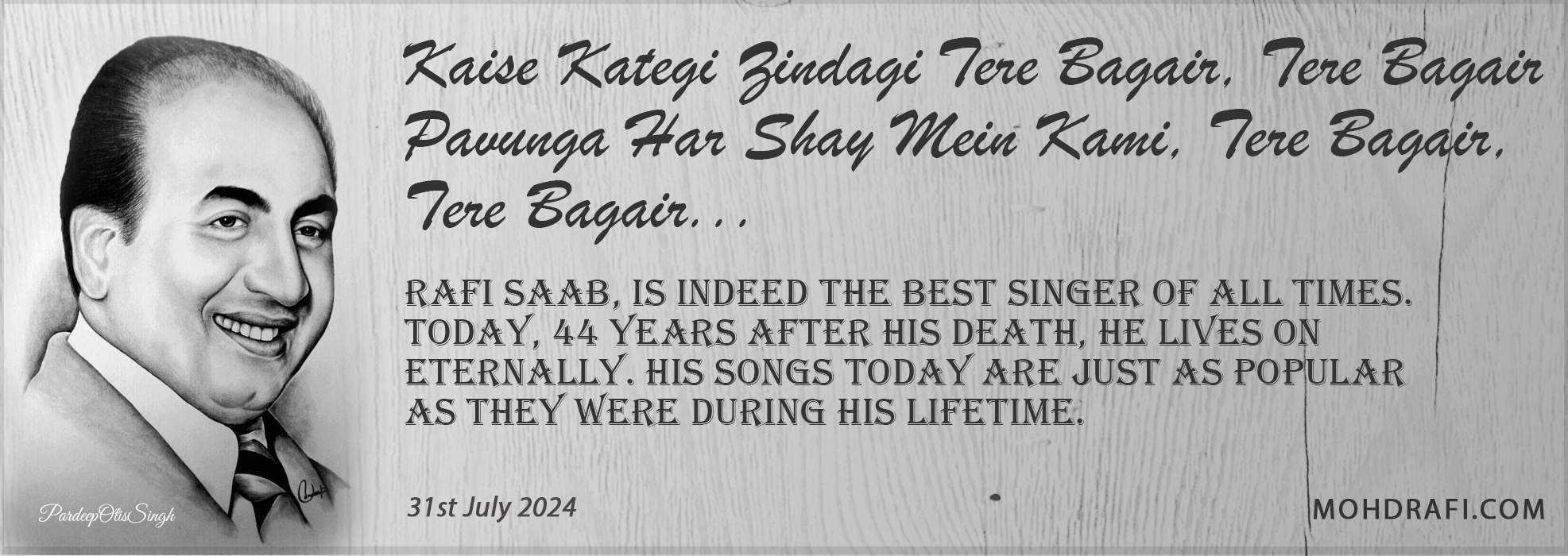
Rafi Sahab, the greatest singer ever!
This article is written by Raghav
Mohd Rafi was a great singer, unparalleled, and there can never be another Rafi. I have been a great fan of Rafi and I have always loved to enjoy his songs, analyze them and appreciate them all the more.
Rafi had 4 unique qualities:
- Quality of voice
- Voice differentiation
- Ability of expression
- Mastery of late entry
which are unique to Rafi and Rafi alone.
Tonal quality of voice and timber was so smooth, free flowing, and of perfectly circular, uniform cross section without any burrs, rough edges or splashes, or out of shape even for a brief moment & the quality of Rafi’s voice can only be felt, cant ever be described in words, I will however try to visualize the perfection of his voice in physical, tangible terms, imagine a tubular pipe of a uniform cross section and tremendous resilience, perfect shape and it’s flexibility enables it to be stretched (high octaves) without thinning the wall thickness, it can be compressed without affecting the shape (low octave), and can be bent and manipulated at any angle in any dimension without disturbing the shape or cross section (alaaps, murkis, and taans) imagine such a material! I doubt whether material science has progressed enough to produce such material! But Rafi had a voice that symbolized the material!
To see the voice quality in action!
listen to:
O duniya ke rakhwale: from Baiju bawra.
Rafi starts normally with “mehal udaas aur galiyan sooni” and jumps up “dil kya ujada duniya ujadi”. Advances rapidly to “hum jeevan kaise gujarein” peaks at “mandir girta phir ban jaata” and slides down smoothly to “dil ko kaun samhaley”.
The vocal pyrotechnics are superbly smooth and effortless, even Nadia Comenci couldn’t be better!
Jaane Bahar Husn tera: from Pyar kiya to darna kya.
Rafi starts the antara at base level , “hai ye teri mast adayein ye baaq pan” repeats the sentence at double the height, climbs up to “kiranon ko bhi na chhoone doonga tera badan” and descends smoothly and rapidly with “tujhse nazar milaye yeh kiski majaal hai”. Beautiful gliding which no para-glider champion can ever replicate!
Rafi perhaps was the only singer with this rare capability of smooth ascent and descent with such a short runway, his voice was the equivalent technology of V-TOL (vertical take-off & landing) and S-ToL of modern day high-tech Harrier jets!
Rafi was at his peak in the period 1955 to 1965. This decade also was the golden period of Hindi film music. Rafi showcased his unique ability of voice differentiation; he used to modify and distinguish his voice to suit different heroes without compromising his voice quality. Hearing a song in Binaca Geet mala, much before the release of the film, we could recognize who the song is pasteurized on!
One could clearly identify the hero, Dilip Kumar, Devanand, Shammi Kapoor, Rajendra Kumar, or Dharmendra. Lata too used to sing differently for Nutan and Meena Kumari, Asha used to distinguish between Asha Parekh and Helen, but Rafi’s versatility and broad range was far superior in all respects.
Rafi even had a different style for MD,s. Rafi’s voice had subtle difference for Naushad, O.P.Nayyar, S.J, and Madan Mohan, SD Burman.
Rafi had this talent to capture the mood of the song, express the very essence of lyrics as well as the overall theme and reflected the situation as pasteurized on screen!
To understand this unique talent recall in your mind:
Too kahan, yeh bataa, is nasheeli raat mein from Tere ghar ke saamne.
Sheer desperation of a physically tired lover seeking to locate his beloved, depicted so beautifully!
Mein nigahein tere chehre se hataoon kaise from Aap ki parchaaiyan.
Sheer helplessness of a love struck hero!
Nache man mora from meri soorat teri aankhen
Sheer ecstasy of an artist on seeing the converging clouds, dying to dance euphorically!
Baazi kisi ne pyaar ki jeeti ya haar di from Nazraana.
A philosophical shrug of shoulders, a humble, graceful acceptance of the ironies of fate!
Bahut sahi gamen duniya magar udaas na ho from Aaj aur Kal
A gentle, consoling, optimistic solace with assured promise of a better tomorrow!
Is rang badaltee duniya mein from Raajkumar
A persuasive advise of a deeply concerned well wisher!
Tere mere sapne from Guide
A reassuring promise of assurance to a grief sticken friend!
There are many more such examples.
Another great quality of Rafi was his superb late entry which was as enthralling as GR Vishwanath’s late cuts in his prime!
Rafi used to enter the song halfway through, very coolly, very surreptitiously and suddenly capture the center-stage, which used to get the other singer/s clean bowled! Examples:
Awaaz deke humein tum bulao from Professor.
Rafi enters in later half, Lata is left behind trying hard to catch up!
Par thehar woh jo wahan in mujhe gale se lagao from Nayi umar ki nayi fasal
A stern interjection, a strong rejoinder that has Asha reeling!
Bahut sahi from Aaj aur kal
A melodious, cool, interjection so reassuring, so comforting that leaves nagging Asha stuck!
There are many more such songs where Rafi making a late entry, captures the centrestage so effortlessly! There a few, not so well known songs in which Rafi has excelled superbly, to name a few:
- Raaz-e dil unse chhupaya na gaya: Apna bana ke dekho
- Zara sun haseena ye nazneen: Kaun apna Kaun paraya
- Ankhiyan sang ankhiya lage aaj: Bada Bhai
- Zara saamne to aa voh chhalie: Janam janam ke phere
- Yehi hai tamanna: Aapki parchhaiyan
- Apni to har aaah: Kala Bazar
These are some of rare songs.
Rafi sahab was great and is great, he will live in our hearts forever and ever.
– Raghav
i was allrealy fan of m rafi but kishor and mukesh was also good.but the voice and all feild of music is slave of talent of m rafi.he was very good singer.i am big fan of m rafi.
For all those kishore kumar fans go and visit his website of which I’m sure there must be a few of. Kishore kumar needed to stick to his yodeling and leave the singing to artists like the late great mohd rafi who could sing anything and make it sound good and I totally agree with meena there really is no substitute for him
and he’ll remain the best singer of all time until time it’s self runs out.
Everyone knows that Rafi was the best and there is no substitute for him. The popularity of his songs speak for themself. The truth is that KK doesn’t even come 2nd or close. There is no denying that Rafi could sing any song and sing it well not like other singers who sang songs but what a disaster. If you hear the same song sung in the films such as Junglee by lata and Rafi I’m sorry Rafi wins hands down. He made huge stars of people like Biswajeet, Rajendra Kumar, Shammi Kapoor, Pradeep Kumar and these stars know especially Biswajeet that their films would have been flops if it wasn’t for the beautiful music and songs and Mohd rafi who did the playback singing for them and at least most of them had the decency to recognise this fact unlike some people who choose to ignore the facts that say without any doubt that Rafi was the greatest and god bless is soul as he gave millions so much pleasure through is music there will never be another Rafi.
Hi everybody
I don’t know about music,I am looking for help to help a kk fan who asked on
December 21st, 2010 at 7:28 pm but still not have answer by kk fans on KK site
I am a tremendous fan of Kishoreda. I completely go with you all that KK was a versatile singer. Recently I read in this site someone mentioning that KK didnot sing the tan sargam part of Pag Ghungroo Bandh Meera Nachi thi song and some pandit sang that part of the song for him. Now this fact quite baffled me because where KK has sung so many semi-classical songs with different tan sargam e.g. Log kahte hain main sharabi hoon, Kabhi bekasi ne mara etc. why in the world he could not sing that pa ni sa dha pa ni sa dha part of that song I really do not understand. Please can you clarify what had actually happened. LONG LIVE KISHOREDA THE ACE PLAYBACK SINGER OF ALL TIMES.
http://www.yoodleeyoo.com/trivia/kishore-kumars-andaz-e-ghazal.html#comment-71128
Dearest kk fans please visit kk site and give your vote to him because he need your votes, kk was a great singer I agree but can’t be compare with mohd rafi because mohd rafi is from other world,mohd rafi was is and will be from 1 to 10 as said by great singer Mannay day, As Ravi the music director that he had been force to use kk not mohd rafi as film maker request but after the song recorded again film maker request to rerecord again but with mohd rafi voice, u can find the interview on YouTube if u like it I have help u to find out it for u…
Re post 12.. MrPrashant, My friend a loyal kishore kumar fan just loved mohd rafi songs after he heard rafi saaab sing those 4 lines in Kya Mausam hai…. today, he attends all our mohd rafi concerts in mumbai and is a die hard m.r. fan.
the hoarse voice vs soothing voice – could’nt be masked here prashant ji. hear it. u will notice it.
thanks
rafi saab had so many qualities.i think the only singer who
can keep sweetness in high pitch as well as in low pitch is
rafi saab.we have singers who have very sweet voice but
in high picth and low pitch they have problem while
rendering a song.
it is sorry to say that kk spoiled the song ” salaami ishque
meri…………
Post no. 17.
Anilji, your opinion shows your own view, not most of the people as you claim. The worst voice I have ever heard which is capable of destroying a song. The way KK made that late entry and demostrated horse voice struggling to keep up with lataji, all I can say that I salute your courage for defending your opinion.
sorry but kishore has done superb job in saalame ishq . a rafi fan only told me that the voice of kishore here has very weeell suited AB annd his entry. most people say that kishore has sung this song extremely well.
my favourite late entry of rafi saab is from the film
“amar akbar antoney” duet song sung by rafi saab
lataji,mukesh and kk.
when rafi saab start singing “ek tho akbar ka kalaam”
the entire song changed.how beautifully rafi saab
pronounce the words and push others to back.the
sound of rafi saab,the handsome rishi kapoor and
the beautiful neetu sing.who can forget the lines of
rafi saab.
Dear Mr Raghav,
Nice write up. U have put up the spectrum of playback singing very well. There can never any one like or near rafi sahab in his talent, voice quality, singing ability, humility in all his aspects of life & grace. Why compare him to anyone. All his contemporaries were unique in their own domain, but rafi sahab excelled beyond description in their unique respective domains beyond any comparision! his domain was all encompassing!!! All moods, nuainces, emotions & what have you were easy pickings for him. Talking abt late entry-U all missed out on the famous Qawwali-Na to caravan ki talash hai… can one imagine what a singer like rafi sahab could do to the qawwali-infuse everything-life, breath, vigour, strength, honour….the list goes on!! lets forget second choice citizens. They speak for their their own self!! Let them also enjoy the phenomena called rafi sahab!!
the versality of rafi saab cannot be put in words.
it is juat like an ocean.
sorry for the next words.in the film “muqaddar ka
sikender” there is a duet song of lataji and kk “salaami
ishque meri jaan”.lataji sings it very well.in that kk had
late entry and we can see how beautifully he killed the
lines…………
Rafi’s late entry excellence is as great as his first entry excellence, when other singers following his start, struggle to match him! Take the example of ‘dil ne phir yad kiya ‘ ( RAfi, Suman & Mukesh) OR the popular qawali, ” hei agar dusman dushman, zamana ….” where Asha is forced to sing in a different style to avoid comparison OR ‘muje koi muhabat ka sahara mil gaya hota, agar tufan nahin aatha kinara mil gaya hotha” with latha, where even a great singer like latha had to struggle to retain the feel and pathos in Rafi’s singing !!! !! Sooooo many examples! Truly, Rafi belonged to a unique class shared by Rafi only!!
@ Mohan Flora
Dear Mohan. I hope that you will acquire more knowledge and taste about music as life goes on. On what basis you made the highly objectionable comment ‘Kishore running for cover’ in song Kya mausam hai? In fact when Rafi sahab makes his entry in that song, the listener is suddenlt surprised by the fall in quality of voice of teh singer from KK to Md Rafi. However, Rafi compensates for what he lacks in natural voice by singing very well his part and one definitely appreciates his singing talent in this song. But, Rafi will never be comparable to Kishore Kumar simply because of the unmtached voice quality that God had given to KK. I have lots of respect for Rafi and he is my second favourite singer. But when i see comments like ‘KK running for cover’, I can just laugh and lament at the lack of music understanding amongst the listeners.
In the song ‘Kya Mausam Hai’ KK sings the most dofficult low notes, which he is able to carry out well due to his excellent deep natural voice. When he singhs ahh hahhah khota hai to kho jaane do..you can just nod in amazement at that stanza.
I love Rafi sahab also. But being a Rafi fan doesnt mean that you will denigrate a God gifted talent like KK.
Mohd. Rafi was a greatest singer in world.
rafi sahab’s voice was divine. We can just recall the song “Leader- Ek shahenshah ne”. Just close the eyes and experience the song. No need to have a look at Taj mahel, you can just feel the greatness of Taj Mahel” There are many almost all the songs, even from the last one from “Aas Pass”, one can feel Rafi Sahab as an actor on the screen, or one who is acting is the same actor and singer. “Jangal me mor nacha”, for Johny Walker”. Just matchless. One for Dilip sahab, ” Tute hue khabo me”, and there are many more. The matchless singer, what else anyone can say.
In a concert at Royal Elbert Hall, London Rafi Saab givens a totally new dimension to the song ‘O Duniya Ke Rakhwalle’. In the song there is a line ‘Mahal Udaas Or Galinya Suni’ is sang in several times different styles. It speaks Rafi Saab’s voice control is just great.
Great article. I am just sad I dont know how to reply properly, though, since I want to show my appreciation like many other.
Add to the above list the late entry song that beats the mother of late entry songs as mentioned above – Remember the song,” Kya mausam hai,
eh diwane dil, chal kahin door nikal jaayen,”started and sung so well by
Kishore and Lata- so you think?-until Rafi comes up with,”yeh mastiyaan
yeh bahaar phir ho chala bekarar.” and you go wow! wah-wah.Aur kya
kahen, bhai?
Agreed with all about Rafi’s late entry mastery. Add to the list the following: Ruksasa mera naam from The Great Gambler, Poocho na yaar kya hua from Zamane Ko Dikhana Hai, and the mother of all late entry songs where he has both Kishore Kumar and the female singer running for cover- yeh duniya ke badaltey rishtey from Badaltey Rishtey. Remember the Amitabh starrer Muqadar ka Sikandar? Isn’t it Rafi’s one line title song you remember while leaving the theatre rather than Kishore’s full song.That is the mastery Rafi commanded on all other singers then and now, too, 25 years later.
I completely agree with you Vikram. In the song “O mere sona re sona re..” the only stanza I always recollect is the Rafi one “O fir humse na ulajhna..” and the song. “Main yeh soch kar..” is song ke baare mein kya kahoon, no words to describe it; its my favourite; he has sung it in such a way that the first time you hear it and you are stunned the song is so short and yet so moving.
– Manish
Bhatia Sahib,
First, on dekho kasam se dekho kasam you have simply reflected my emotions. Rafi Sahib’s Kya Lageye tumne yeh kasam kasam yeh towards the end is mesmeric and steals the show.
Recently I watched Chambal Ki Kasam. Actually I got that cassette to watch Simite Hue Yeh Ghadiyan Phir Se Na Simat Jayee. This is one of my all time Rafi/Lata favorites of 70’s. How beautifully both of them have rendered it? Though Lata’s lines are more, yet Rafi Sahib’s overlapping lines create magic. There was yet another song, which I hadn’t heard in Rafi’s voice pasteurized on Shatrugan Sinha in the same movie, a good song with Sahir’s lyrics and Khayaam’s music. It came as a bonus. I am gonna play it again. Chambal Ki Kasam was released in Dec, 1979. All I must say is that Simite Huve Yeh Ghadiyan is a terrific song rendition /music/lyrical qualitity are at its best. I can’t find any other song of 1979, which is as intense as Simite Huve Yeh Ghadiyan. I have observed that whenever Rafi and Lata sang together the result was sheer magic. Both of them used to put in something extra in the song. In my opinion Rafi must have always thought of Lata as real competition and vice-versa. That probably explains that they were always extra careful while singing together as though they had a point to prove to each other. Let me provide a list of few Rafi/Lata duets in the decade of seventies which stormed the popularity charts, had the mass as well as the class appeal :
1. Yeh Dil Diwana Hae (1970)
2. Yun hi tum mujh se baat karte hoon,ya koi pyar ka irada hae (1970)
3. Hai Re hai Neend Nahin Aaye (no 1 song of 1970 in terms of popluarity)
4. Mere Duniya Mein Tum Aaye kya kya (1970)
5. Yeh Dil Tum bhin kahin Lagta Nahin (1968)
6. Saatheiya Nahin Jana ki jee na lagee (1969)
7. Kitna Pyara Wada hai in Matwale Ankho Mein (1971)
8. Jhil Mil Sitaron Ka (1971)
9. Gorre ke haath mein (1971)
10. Rut Hae Milan Ki Saath mere aa re (1971)
11. Itna to yaad hae mujhe (1971)
12. Dol Sajna Dol Janne (1971)
13. Mein Tum Se Milne Aaye Mandir Janee ke Bahane (1971)
14. Tere Nainon Ki mein deep (1972)
15. Patta Patta Buta Buta (1972)
16. Tere Bindiya Re (1973)
17. Tum Jo Mil Gayee Ho (1973)
18. Wada Karle Sajna (1974)
19. Ek Dhal Par Toota Bole (1974)
20. Ek Mahel Ho Sapno Ka (1975)
21. Yeh Reshme Pazeb ke Jhankar (1976)
22. Ki Aaja Tere Yaad Aayee (1976)
23. Aadmi Musaphir Hae (1978)
24. Mujhe Chu Rahe hai Teri garam sanse (1978-79)
25. Baho mein tere maste ki (1979)
26. Dafli wale (1979)
27. Koyal bole (1979)
28. Simite Huva Yeh Ghadiyan (1979)
29. Koyal Kyon Gayee (1972)
30. Yeh Gotte Dar Lenghan(1981)
31. Ashao ke Sayee(1980)
And many many more.
– Naveen
Excellent post – both by Raghav and Jayendran Jayaraman!
I never thought in terms of “late entry” but whenever I heard this song, “Dekh qasam se, qasam se kahatay hain tum se haan, tum bhee jalogay…” I always thought to myself … Rafi sahib comes in towards the end of the song and dominates it right away with “kyaa lagayee tum ne yah qasam qasam se..” I didn’t know that the technical term for this was “late entry” – thanks for educating me.
Incidentally, everyone talks about O duniyaa ke rakhwaalay as Rafi sahib’s best. Only last night I was playing this song from Shabaab “Yehi armaan le kar aaj apne ghar se hum niklay…” In this song Rafi sahib goes upto taar saptak dha in “meri ujaDi huee mohabbat (this is where he hits it) kee hansee mil kar uDaao tum..” I think in this song he goes even half a note above the original version of O Duniyaa ke rakhwale.. At least that’s what my harmonium tells me. I think this song has not gotten its “due” respect.
– Rajinder Bhatia
Extremely well written Mr. Raghav!!! You have very beautifully captured the feelings of all Rafians!!! I cannot agree more that he always outsmarted co-singers with his late entry. “Awaaz Deke” is a standing testimony to this fact!! Also holds good is that fact that he maintains his superiority even if he starts the song; example “Woh Jab Yaad Aaye” from Parasmani!!! A late entry by Lata is hardly noticed, with Rafi leading the way in the song!!!
Few more songs that we can add to prove Rafi’s superior expressions:
Abhi Na Jao Chodkar (Hum Dono):
Sheer desperation by the hero begging his lover not to leave. I have not come across any expression (written/sung/composed) that could ever beat this one!!! Absolutely amazing!!!
Deewana Hua Badal (Kashmir Ki Kali):
Absolute ecstasy of a lover who wants to tell the world about his new found happiness!!! As S.P.Balasubramaniam puts it “Can anybody ever say ‘ma’ (yeh dekh ke dil jhoomaa) like that????” NEVER!!
Kabhi Khud Pe (Hum Dono):
The expression of sheer sorrow and misery of a man who has lost it! The ease with which Rafi trascends the highs and lows in this song is simply unmatched!!! The alaaps and brighas are simply out-of-the-world!!!
The above songs are the ones that have affected me the most. I may have listened to each of these songs atleast 2000 times, but they do not cease to leave bewildered every time I hear Rafi’s voice!!!!
– Jay
One song that I know where Rafi comes in late is “Hum intezar karenge” from bahu begum where Asha stars the song but is beaten big time by rafi when he starts “Yeh intezar bhi ek imtihaan hota hai… ” and of course “O mere Sona re sona re” from Teesri manzil, Rafi comes in late and captures the center stage. The song “Chura liya hai tumne jo dil ko” he comes in late and sings it so well.
Song which I just love the start of Rafi is “Saathi na koi manzil” from bombai ka babu. I just love the way Rafi hums in the start, one has to keep the volume of the song real high to hear him fully, he is just too sweet.
I also like the song “Mujhko apne gale laga lo” from humrahi where Rafi is with Mubarak begum. Rafi sings the second paragraph and is unbeatable. I love Rafi’s “Mein yeh sochkar uske darr se utha tha” from Haqueekat.
I am sure there never will be a singer better than him. And when one says that one could identify the actor from the style of Rafi’s singing, he is 100% right. Unlike today’s singers who could sing for anybody or nobody, it would hardly make any difference. Why? Is it that those were the days of Good music?
– Vikram